How to get money back after being scammed: who to call first, by how you paid
Call the company you used to pay, today, and ask it to reverse the payment. Here's who that is for each way of paying, and the fee-charging "recovery" offers to ignore.
If you paid a scammer, contact the company you used to send the money right away, tell them it was a scam, and ask them to reverse the payment and refund you. That means your card issuer for a credit or debit card, your bank for Zelle or a bank transfer, the app for Venmo, Cash App or PayPal, and the card's issuer for a gift card. The FTC warns the money may already be gone, but says it's always worth asking, and calling quickly gives you the best chance.
Being scammed doesn't mean you were careless. These people do this all day, and they pick payment methods that are hard to trace on purpose.
Who do I call first to get my money back?
Find the way you paid in the table below. Use the number on the back of your card, in the app, or on the company's own website. Never use a number the scammer gave you, or one from an email or text about the payment.
| How you paid | Who to contact | What to ask for |
|---|---|---|
| Credit card | The card issuer | Report the charge as fraud and ask for a refund |
| Debit card | Your bank or credit union | Report it and ask for a refund |
| Zelle or bank transfer | Your bank or credit union | Ask them to reverse the payment |
| Venmo, Cash App, PayPal | The payment app | Ask them to reverse the payment |
| Wire (Western Union, MoneyGram) | The wire transfer company | Say a scammer tricked you and ask for a refund |
| Gift card | The company that issued the card | Say a scammer got the number and PIN, ask for a refund |
| Cryptocurrency | The exchange or crypto ATM operator | Report it as fraud and ask for a reversal |
| Cash sent by U.S. mail | U.S. Postal Inspection Service, 1-877-876-2455 | Ask about intercepting the package |
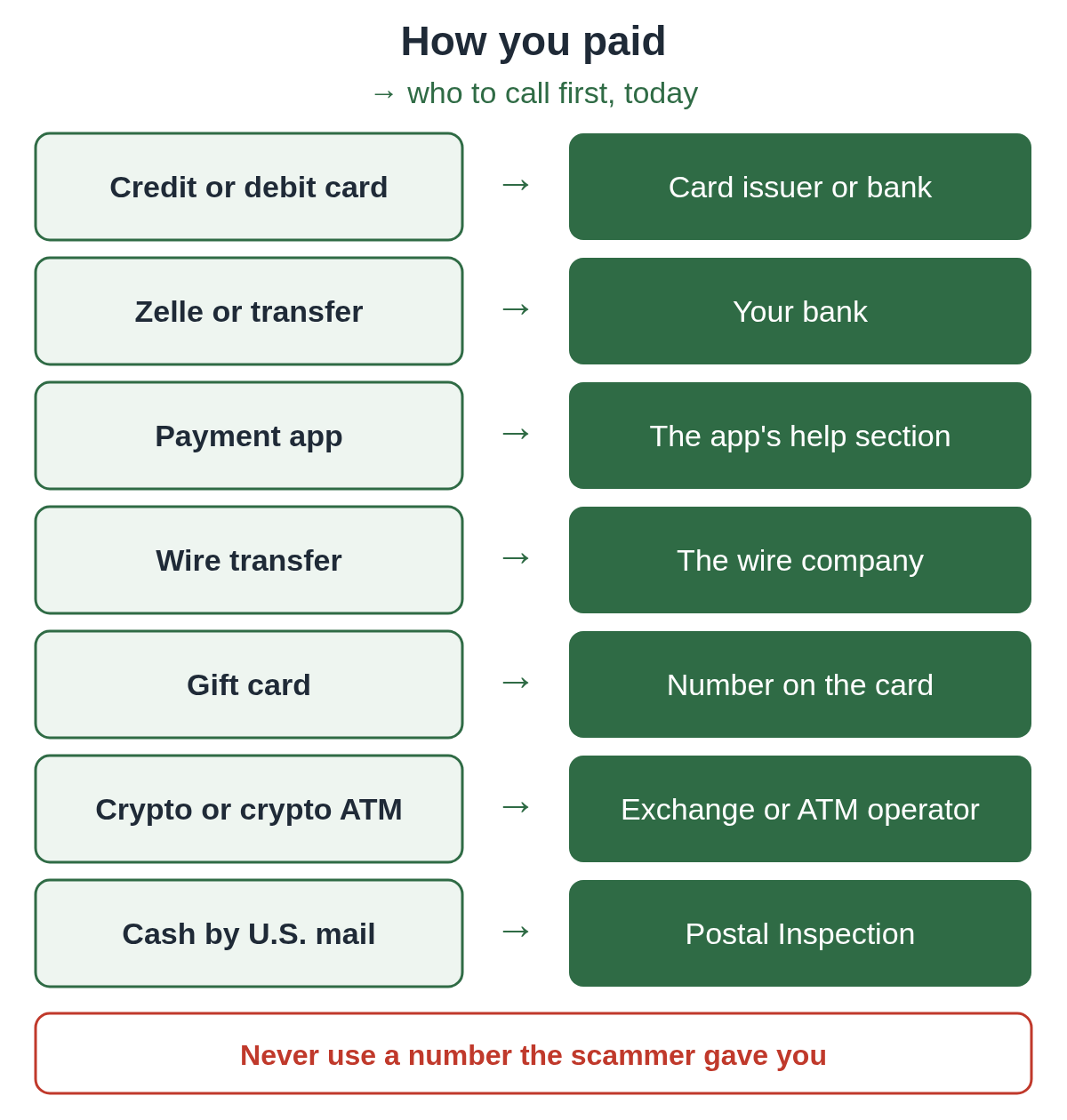
If you paid more than one way, start with whichever payment was most recent. A payment that hasn't gone through yet is the easiest one to stop.
Can I get my money back if I paid by credit or debit card?
Cards give you the most protection, so call the issuer first. The FTC's advice covers both cases: someone used your card without permission, or a scammer tricked you into paying with it. Either way, call the number on the back of the card (or report it in the card's app) and ask for a refund.
When someone else used your card, federal law limits what you owe. For credit cards, the most you can be held responsible for is $50. If only the card number was used (the card itself was never lost), you aren't responsible for charges you didn't authorize.
Debit cards have tighter time limits, which is why speed matters. According to the FTC, this is the most you can lose from unauthorized debit card use:
| When you report it | Most you can lose |
|---|---|
| Before any charges are made | $0 |
| Within 2 business days of finding out | $50 |
| After 2 business days, within 60 days of your statement | $500 |
| More than 60 days after your statement | Everything taken, and possibly money in linked accounts |
After the call, the FTC suggests following up in writing with your account number, when you noticed the problem and when you first reported it.
Can I get money back from Zelle or a bank transfer?
Call your bank or credit union right away and ask them to reverse the payment and refund your money. That's the FTC's advice for Zelle and bank transfers.
Be clear about who pressed send. If the scammer moved money while they were in control of your computer or account, say so plainly: you didn't make that transfer. If you sent the money yourself because you were tricked, say that too. Banks don't always refund a payment you sent yourself, but they can't help with one they never hear about.
Write down the date, the name of the person you spoke to and any case number. You'll need them if you follow up.
What about Venmo, Cash App or PayPal?
Report it to the payment app straight away and ask them to reverse the payment. The FTC keeps a list of how to report a scam to popular payment apps. Use the help section inside the app itself, not a "support number" you find in a search result, since scammers advertise fake ones.
I sent a wire transfer. Can it be stopped?
Call the wire transfer company, such as Western Union or MoneyGram, immediately. Tell them a scammer tricked you into sending the money and ask for a refund. The FTC lists how to report a scam to popular wire transfer companies. If the money hasn't been picked up yet, there may still be time.
Can I get money back from a gift card scam?
Sometimes. The FTC says to:
- Call the company that issued the card, using the number on the back.
- Tell them a scammer tricked you into giving them the card number and PIN.
- Ask for a refund.
Keep the card and the receipt. You may need them for your claim. The FTC lists contact details for popular gift card companies.
I paid with crypto or at a bitcoin ATM. What now?
Contact the exchange or the ATM operator immediately, tell them it was a fraudulent transaction, and ask them to reverse it. Then report it at ReportFraud.ftc.gov.
Be ready for a harder road here. The FTC says crypto payments don't have the same legal protections as cards, so it can be hard to get money back. Some states have passed laws that might help, and the FTC points to the National Conference of State Legislatures to look up yours.
I mailed cash. Can I get it back?
Call the U.S. Postal Inspection Service at 1-877-876-2455 right away. For a fee, USPS can intercept a domestic package that hasn't been delivered yet and send it back. If you used FedEx or UPS, call them as soon as you can.
What if the scammer also had access to my computer?
Then there are two jobs: the money, and the computer. Do the money calls first, from a different phone. After that, the FTC suggests updating your security software, running a scan, changing your passwords and turning on two-step sign-in.
Our two-minute checklist covers the first steps on a Windows PC, and what to do after a remote access scam covers the days after. If the caller showed you a "refund" that was too big and asked you to send the difference back, read the refund scam where they say they refunded too much. That money was moved from your own account.
Where should I report the scam?
Reporting doesn't replace the calls above, so do it once those are done.
- Report it to the FTC at ReportFraud.ftc.gov.
- Report it to the FBI's Internet Crime Complaint Center at ic3.gov.
- Report it to your state attorney general, as the FTC suggests.
- If you gave out your Social Security number, go to IdentityTheft.gov for a recovery plan.
Will someone help me recover my money for a fee?
No one legitimate will. After a scam, many people hear from someone offering to get their money back. The FTC says these refund and recovery scammers buy lists of people who've already been scammed. They may claim to be from a government agency (even the FTC), a consumer group or a law firm, then ask for a "retainer fee", a "processing fee" or your bank details to "deposit the refund".
The FTC says neither government agencies nor legitimate organizations will ask for money or financial information in exchange for help getting a refund. Real FTC refunds are listed at ftc.gov/refunds, and the FTC never asks for fees, your Social Security number, bank details or remote access to your computer.
Keep a record while you make the calls
Each call goes better when you have the facts in front of you: the date and time you paid, the amount, the method, any transaction or confirmation number, and the phone number or website the scammer used. As you call each company, note who you spoke to, the case number and what they promised to do next.
Printable call log: getting your money back after a scam (PDF)
If this happened to a parent, our guide on what to do when a scammer had remote access to a parent's computer covers how to help without blame. If it started with a call about an order you didn't make, see how the fake Amazon call works. You'll find more on how these tricks work in our scams section.
These steps were checked against the FTC's guidance as it stood in November 2026.
Questions people ask
How long do I have to report a debit card scam to my bank?
Call the same day if you can. Under the rules the FTC describes for unauthorized debit card use, reporting within 2 business days limits what you can lose to $50. Wait longer and it can rise to $500, and after 60 days from your statement you could lose everything taken.
Someone offered to get my money back for a fee. Is it real?
Almost certainly not. The FTC says neither government agencies nor legitimate organizations ask for money or financial information in exchange for help getting a refund. Real FTC refunds are listed at ftc.gov/refunds.
Can I get money back from a gift card scam?
Sometimes. Call the company that issued the card using the number on the back, say a scammer got the card number and PIN, and ask for a refund. Keep the card and the receipt.
Sources
Drafted with AI assistance from public sources, then checked and approved by Jake Wilder, Security Awareness & Communications Lead on . See how we work, or tell us about a mistake at support@xcelcor.com.
More on Scams Family and older relatives Remote access scams