Family safe word: how to pick one and use it when a panicked call comes in
A private word your family agrees on, so a cloned voice can't talk you into sending money. How to choose it and use it.
A family safe word is a private word or phrase that everyone in your family agrees on, so you can check that a frightened call really comes from your child, your parent or your grandchild. The FBI recommends one because scammers can now copy a person's voice from a short clip. If the caller can't give the word, hang up and call that person back on the number you already have.
In short:
- Pick two or three plain words that have never been online.
- On a scary call, ask for the word. Don't hint at it.
- No word, or a dodge? Hang up and call back on a number you know.
Why do families need a safe word now?
Because a familiar voice is no longer proof. The FTC warns that a scammer with a short audio clip of someone's voice, perhaps from a video posted online, and a voice-cloning program can call you and sound just like your family member. The FTC's advice is blunt: don't trust the voice.
In December 2024 the FBI's Internet Crime Complaint Center said criminals use AI-made audio to pose as a close relative in a crisis and ask for money right away, or demand a ransom. The first tip on its list is to create a secret word or phrase with your family to verify their identity.
A safe word works because a clone can only repeat what the scammer feeds it. If the word was never said online, the scammer can't know it.
How does the fake emergency call play out?
The FTC describes the same pattern again and again. Knowing it makes the call easier to spot, even when the voice sounds right.
- It starts with panic: a loved one is in trouble after an accident, an arrest, a hospital visit or a trip gone wrong.
- A second voice may take over, saying they're a lawyer, a police officer or a doctor.
- You're told to keep it secret from the rest of the family, so nobody can talk you out of it.
- The money has to go today, by wire, gift cards, cryptocurrency or a payment app.
The secrecy and the rush are the real tells. They're there to stop you from doing the one thing that ends the scam: calling someone else.
How do you pick a good family safe word?
Choose something you'll remember when your heart is pounding, but a stranger could never guess.
- Use two or three ordinary words that don't belong together, like a silly phrase only your family would say. Something like "purple toaster" is the idea, but make your own.
- Leave out anything that's on social media or easy to look up: pet names, street names, schools, birthdays, team names.
- Don't use a family joke that's already been told in a video or a group chat.
- Keep it short enough for a grandparent or a young child to say without stopping to think.
Agree on it in person, or on a call you started. Don't text it or email it around. If anyone ever has to use it on a call that turns out to be fake, or you think someone outside the family heard it, pick a new one.
How do you use the safe word on a call?
Ask for it plainly, and let the caller do the work.
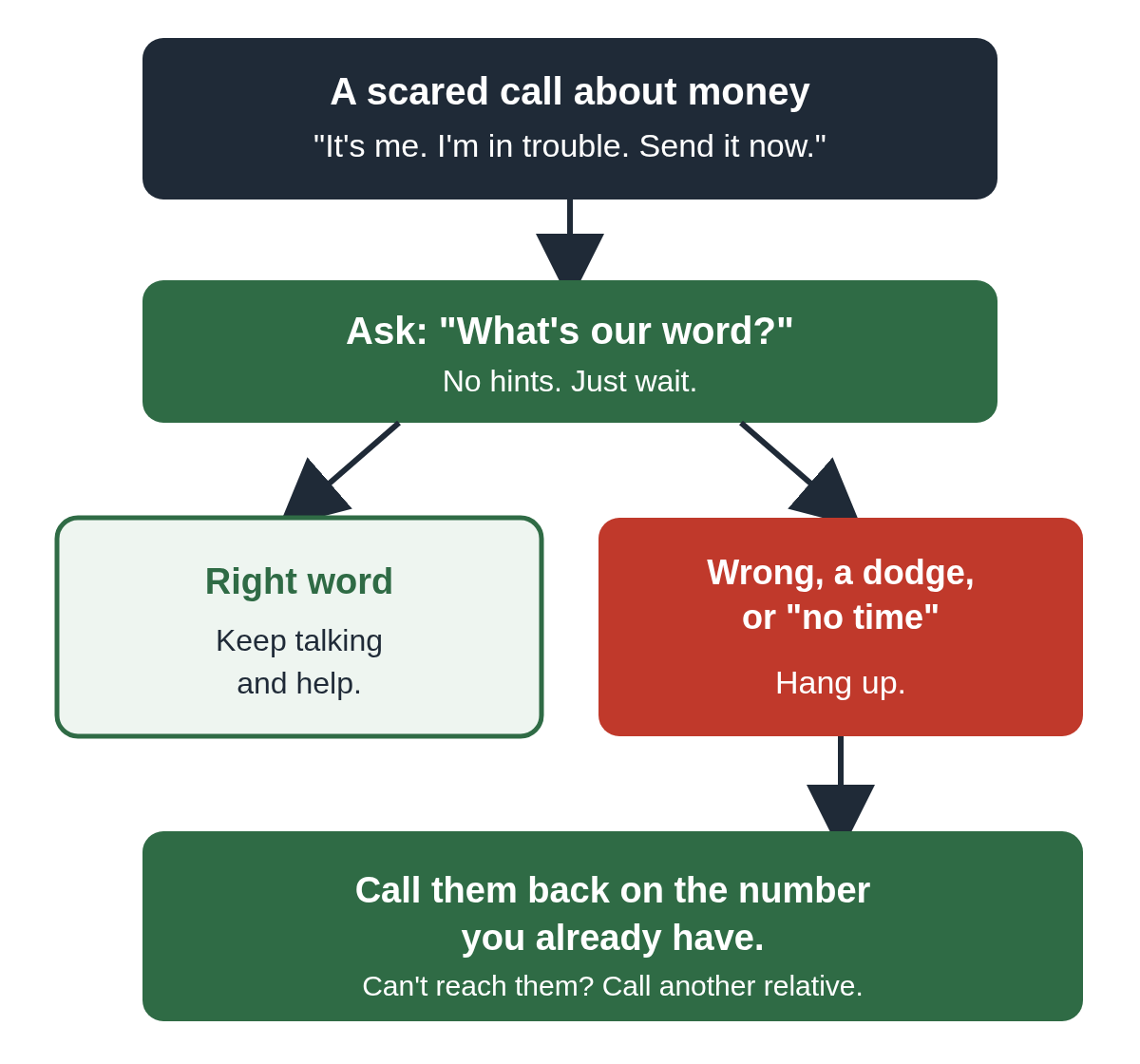
- Say "What's our word?" and wait. Don't offer a hint, and don't ask "Is it purple toaster?", because then you've told them.
- If they give it, keep talking and help.
- If they get it wrong, change the subject, say they forgot, or say there's no time for that, hang up.
- Call the person back on the number you already have for them. If you can't reach them, call another family member or one of their friends, as the FTC suggests, even if the caller told you to keep it secret.
A real emergency can wait the two minutes it takes to call back. A scam can't, which is why the caller will push so hard against it.
What if there's no safe word yet?
The call-back rule works on its own. Hang up, and call the person on a number you know is theirs. The FBI gives the same advice for any caller: hang up, look up the number yourself, and call it directly.
You can also ask a question only the real person would know and that isn't online, like what you ate at a recent family dinner. It's weaker than a safe word, but better than trusting the voice.
Does a safe word help with bank and Microsoft calls?
Not directly, because a bank or "Microsoft" won't know your family's word. The same habit protects you, though. Hang up, and call the company on a number you found yourself: for a bank, that's the number on the back of your card.
This matters because fake emergencies and fake support calls often end the same way: the caller wants money moved fast, or wants you to install a program so they can "help" on your computer. A real bank won't ask you to do that, as we explain in why a bank asking you to install AnyDesk is a scam.
How to set it up with your family
Make it a five-minute talk, not a lecture. Most people like the idea once they hear that voices can be copied.
- Pick the word together at a family meal or on a video call you set up.
- Include the people most likely to get the call: grandparents, and teens who post videos.
- Agree on the rule as well as the word: "If it's scary and about money, we always call back."
- Print the card below for the fridge or the phone table. It has the steps and lines for the numbers to call back, but no space for the word itself, on purpose.
Printable card: our family safe word rule (PDF)
If a parent is the one who'd take the call, our post on how to talk to elderly parents about scams has scripts you can use word for word, and the guide on protecting your parents from remote-support scams covers the computer side.
What to do if you already sent money
Act today. These calls catch careful people, and moving quickly helps.
- Call your bank or card company on the number on the back of the card and tell them it was fraud.
- If you paid with gift cards, call the gift card company and ask if the money can be frozen. Keep the cards and receipts.
- Report it to the FTC at ReportFraud.ftc.gov and to the FBI at ic3.gov.
- If the caller also got into your computer, follow our two-minute checklist, then see what to do after a remote access scam.
Where Xcelcor Guardian fits
A safe word protects the phone call. If a call ever moves to "let me connect to your computer", Xcelcor Guardian lowers the risk on a Windows 11 PC: it holds every new remote connection, from AnyDesk, TeamViewer, Quick Assist and others, until the account holder approves it by email or on xcelcor.com. The person at the PC only gets a Refuse button, so a caller can't talk them into letting someone in.
More posts for whoever looks after the family's tech are in Protecting family.
Questions people ask
What is a good family safe word?
Two or three ordinary words that don't belong together and have never been posted online, like a made-up phrase only your family would know. Avoid pet names, street names, birthdays and anything on social media.
Can a scammer really copy my voice?
Yes. The FTC says a scammer with a short audio clip of your voice and a voice-cloning program can make a call that sounds like you. The FBI recommends a secret family word for exactly this reason.
Should I send the safe word by text or email?
No. Agree on it in person or on a call you started. Messages can be read on a lost phone or a hacked account, and then the word stops being private.
What if my parent forgets the safe word?
The call-back rule still works without it: hang up and call the person back on the number you already have. Write the rule, not the word, on the printable card.
Sources
Reviewed by Dana Cross, Trust & Distribution, on .
Last updated