Scam calls show your local police department's real number, then threaten arrest or ask for money and codes
Scammers fake caller ID so the call looks like it's from your local police, then demand payment to avoid arrest or ask for codes. Hang up and call the department yourself.
The short version
- In November 2026, police in Glastonbury (Connecticut), Burbank (California) and Jefferson City (Missouri) warned of scam calls posing as their officers, some showing the department's real number.
- Callers threaten arrest over a warrant and demand gift cards or money orders, or ask you to call another number. The FTC says real officers won't call to threaten arrest or demand payment.
- Hang up. Find your police department's number on its own website and call it yourself to check.
- If you paid with a gift card, call the number on the back of the card now. Report the call at ReportFraud.ftc.gov.
- Is it a scam?
- It's a scam. The calls aren't from the police even when caller ID shows the department's real number, and the FTC says real officers won't call to threaten arrest or demand payment.
- Type
- Phone scam
- First reported
- November 3, 2026
- Status
- Still active
- Who it targets
- Anyone with a phone, especially older adults. Police in Connecticut, California and Missouri warned residents in November 2026.
- Tools it uses
- spoofed caller ID, real police department phone numbers, gift cards, money orders
Did this reach you too?
Tell us if it did. It helps us see which scams are going around.
If your phone shows your local police department's real number and the caller says there's a warrant for your arrest, asks you to pay a fine with gift cards, or asks for passwords or codes, it's a scam. Caller ID can be faked, and the FTC says real officers won't call to threaten arrest or demand payment. Hang up, then call the department yourself on the number from its own website.
Which police departments have warned about this?
Several departments warned residents in November 2026 that scammers were pretending to be their officers:
| Where | When | What the callers did |
|---|---|---|
| Glastonbury, Connecticut | Early November 2026 | Claimed to be Police Chief Marshall Porter, said there was an urgent matter and asked people to call a number they gave. Caller ID showed the department's real number, 860-633-8301, according to WTNH and the Newport Dispatch. |
| Burbank, California | November 3, 2026 | Calls looked like they came from the department's official numbers. Callers may demand payment by gift card or money order "to avoid arrest on an outstanding warrant or criminal charge", according to NBC Los Angeles. |
| Jefferson City, Missouri | Mid-November 2026 | Callers said they were a local deputy or officer, told people they had an "outstanding arrest warrant" and needed to pay to avoid jail, and told them not to call the police or sheriff to check, according to the News Tribune. |
The departments' advice is the same: hang up, don't use any number the caller gives you, and don't share personal or banking details, passwords or verification codes. Burbank police said people can check a call on the department's non-emergency line, 818-238-3000, or its general line, 818-238-3333.
How does the fake police call play out?
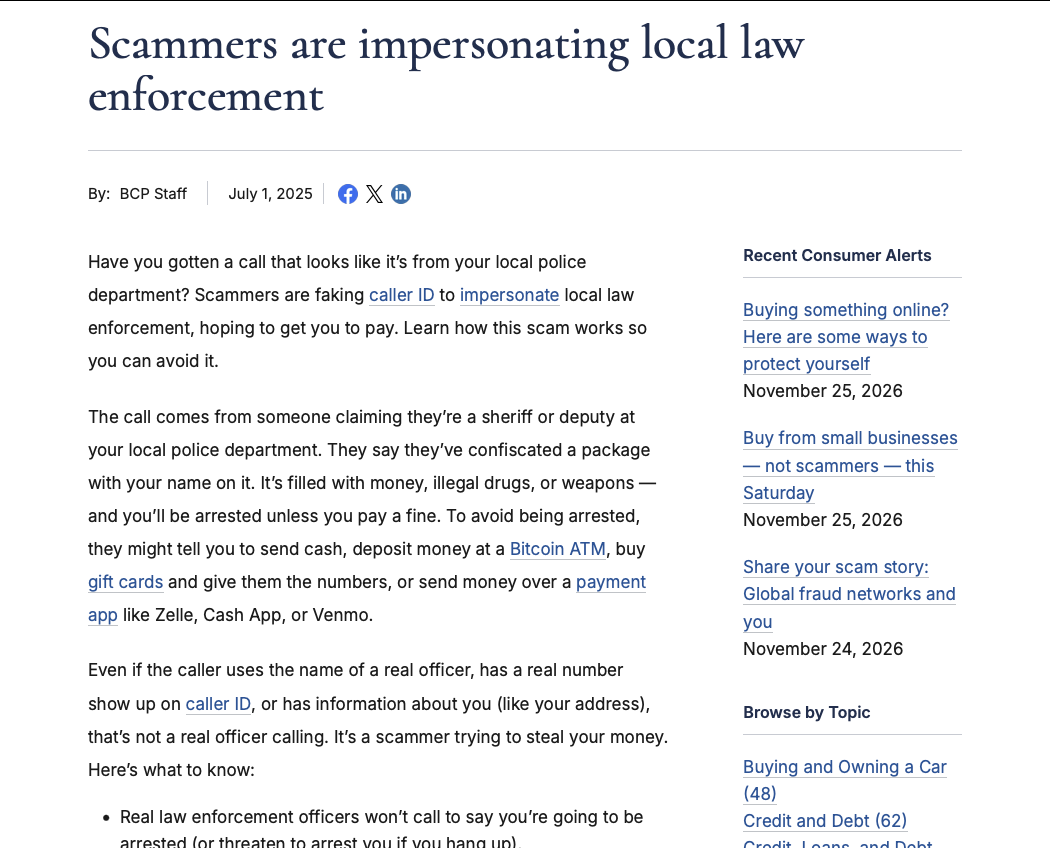
The FTC has described the same pattern across the country. A caller says they're a sheriff, deputy or officer at your local police department. A common story is that they've "confiscated a package with your name on it" full of money, drugs or weapons, or that there's a warrant out for you. You'll be arrested, they say, unless you pay.
To sound real, they may use a real officer's name, make the department's real number show on caller ID, or know your address. The FTC says none of that proves it's a real officer. Then they ask you to send cash, put money into a Bitcoin ATM, buy gift cards and read out the numbers, or pay through an app like Zelle, Cash App or Venmo. Some, like the Glastonbury callers, ask you to call a different number, where the scam continues.
What should I do if I got one of these calls?
- Hang up. You don't have to explain.
- Don't call back the number on your screen or any number the caller gave you. Find the department's number on its own website, or on a letter or bill you trust, and call that.
- Never give a caller a password, a PIN or a verification code from a text. Glastonbury police told residents not to share passwords or verification codes with callers.
- Report the call at ReportFraud.ftc.gov, and tell your local police on their non-emergency line.
What if I already paid or shared details?
- Gift cards: call the company that issued the card, on the number on the back. Tell them a scammer got the card number and PIN, and ask for a refund. Keep the card and the receipt.
- Bank transfer, Zelle or a debit card: call your bank or credit union now. For Venmo, Cash App or PayPal, report it in the app straight away.
- Passwords or codes: change the password for that account from a device you trust, and turn on two-step sign-in. If it was a bank code, call your bank.
- Social Security number or ID: go to IdentityTheft.gov and think about a free credit freeze with Equifax, Experian and TransUnion.
- Report it at ReportFraud.ftc.gov and to your local police.
How do I spot the next one?
- A familiar number on caller ID proves nothing. Scammers fake it for police, banks and government agencies.
- The FTC says real officers won't call to say you're about to be arrested, or threaten arrest if you hang up.
- The FTC also says real officers won't call to insist you pay a fine by cash, gift card, cryptocurrency, payment app or wire transfer.
- Being told not to check with the police or sheriff is a sign of a scam.
The same trick shows up in calls from fake FTC officials who pass you to a "police officer" and in calls that show a real bank's number. If you look after an older relative, our family topic has more on talking through calls like these.
Phone numbers, messages and files linked to this scam
Web addresses are written with [.] so they can’t be clicked by mistake. If something you received matches, it’s this scam.
Phone numbers
860-633-8301The real number of the Glastonbury, Connecticut police. Scammers made it show on caller ID while posing as the police chief (November 2026). The department says to hang up and call this number yourselAlso written +1 (860) 633-8301 · 1-860-633-8301 · (860) 633-8301 · 8606338301
What the message or pop-up says
outstanding arrest warrant
What callers posing as Jefferson City, Missouri officers told people (November 2026)
an outstanding warrant or criminal charge
Burbank, California police say callers demand payment by gift card or money order to avoid arrest on one (November 2026)
confiscated a package with your name on it
A common story in fake police calls, quoted by the FTC
Other signs
Call from the police department's real number asking for gift cards, money orders, passwords or verification codes
Questions people ask
The call showed my police department's real number. Can it still be a scam?
Yes. The FTC says caller ID can be faked, and that a real number on caller ID, a real officer's name or details like your address don't mean a real officer is calling.
Do police call to say there's a warrant for my arrest?
The FTC says real law enforcement won't call to say you're going to be arrested, or to insist you pay a fine by cash, gift card, cryptocurrency, payment app or wire transfer.
How do I check if the call was real?
Hang up, find the department's number on its own website or a letter you trust, and call it yourself. Don't call back the number on your screen or any number the caller gave you.
I already bought gift cards and read out the numbers. What now?
Call the gift card company on the number on the back of the card, tell them it was a scam and ask for a refund. Keep the card and receipt. Then report it at ReportFraud.ftc.gov.
Sources
- FTC: Scammers are impersonating local law enforcement (July 1, 2025)
- FTC: How to avoid a government impersonation scam
- FTC: What to do if you were scammed
- WTNH (via Yahoo News): Glastonbury police warn of scam calls posing as chief (November 6, 2026)
- Newport Dispatch: Scam calls reported in Glastonbury (November 6, 2026)
- NBC Los Angeles: Burbank police warn of caller ID spoofing scam (November 3, 2026)
- Jefferson City News Tribune: JCPD warns about scam calls impersonating police officer (November 15, 2026)
Drafted with AI assistance from public sources, then checked and approved by Jake Wilder, Security Awareness & Communications Lead on . See how we work, or tell us about a mistake at support@xcelcor.com.
More on Scams Family and older relatives