"Veterans Savings Program" postcards, lookalike VA phone numbers and fake veterans grant ads are scams
Scammers use fake VA postcards, lookalike VA hotline numbers and social media grant ads to get veterans' Social Security numbers, bank details and fees.
The short version
- The FTC warned on November 16, 2026 about three tactics aimed at veterans: lookalike VA phone numbers, fake veterans grant ads on Facebook and TikTok, and "Veterans Savings Program" postcards.
- The "Veterans Savings Program" doesn't exist. Calling the number on the card leads to requests for your Social Security number or bank details.
- Don't call the number on a postcard. Call the VA Benefits Hotline at 1-800-827-1000, and apply for benefits only through VA.gov or a VA regional office.
- Report it to the VA's VSAFE hotline at 833-38V-SAFE (833-388-7233) or VSAFE.gov, and at ReportFraud.ftc.gov.
- Is it a scam?
- These are scams. The "Veterans Savings Program" doesn't exist, the VA won't message you on social media, and an accredited VA representative never charges to file a benefits claim.
- Type
- Social media scam
- First reported
- March 2026
- Status
- Still active
- Who it targets
- US veterans and their families, and people helping an older veteran with benefits.
- Tools it uses
- U.S. Department of Veterans Affairs (VA), postcards, lookalike phone numbers, Facebook ads, TikTok ads
The "Veterans Savings Program" postcard is a scam: the program doesn't exist, and the number on the card is there to get your Social Security number or bank details. On November 16, 2026 the FTC warned that scammers are also using phone numbers that look almost identical to real VA hotlines, and ads for fake veterans grant programs on Facebook and TikTok. If you're a veteran, or you help one with benefits, call the VA yourself on 1-800-827-1000 before you share anything.
What the "Veterans Savings Program" postcard looks like
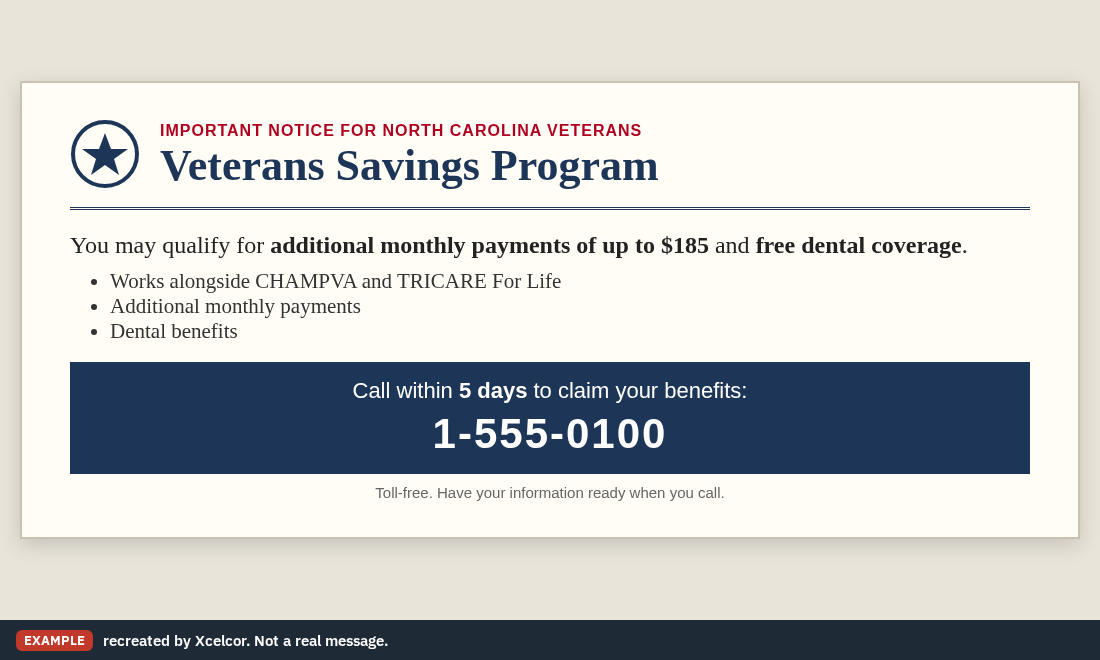
The card comes in the mail and offers extra money or benefits through a "Veterans Savings Program". According to the FTC, it may list the state you live in and mention real VA benefits like CHAMPVA or TRICARE For Life, so it looks official. The North Dakota Department of Veterans Affairs says versions promise "additional monthly payments" and "dental benefits", and some spell it "Veterans Saving Program".
MOAA reported in March 2026 that a North Carolina version offered up to $185 a month and free dental coverage to anyone who called a toll-free number within five days. The card had no return address.
The other two tactics the FTC warned about
Lookalike VA phone numbers. Scammers set up phone numbers that look almost identical to real VA hotline numbers. If you mistype the real number, you can reach them instead. The FTC says they then pressure you to pay for services that are free through the VA.
Fake veterans grant ads on social media. Ads on Facebook and TikTok promote veterans grant programs that don't exist. If you answer, the scammer asks for your direct deposit details and redirects your VA payments to their own bank account. The FTC says the VA will never message you on social media.
How the scam plays out
- You call the number on the postcard, reply to an ad, or reach a lookalike number by mistake.
- Someone says they work with the VA and can get you extra payments, a 100% disability rating or a faster claim.
- They ask for your Social Security number, bank account, VA file number or VA.gov sign-in, or for a fee up front.
- With those details they can redirect your benefit payments, get into your bank account or use your identity, or simply keep the fee.
What to do if you got the postcard or saw the ad
- Don't call the number on the card or reply to the ad.
- If you want to check, call the VA Benefits Hotline at 1-800-827-1000, typed in carefully, or go to VA.gov by typing it into your browser.
- Apply for benefits only through VA.gov or in person at a VA regional office.
- Report it to the VA's VSAFE fraud hotline at 833-38V-SAFE (833-388-7233) or VSAFE.gov, and at ReportFraud.ftc.gov.
What to do if you already called, paid or shared details
- If you gave bank or direct deposit details: call your bank now. Then sign in at VA.gov, or call 1-800-827-1000, and check your payments still go to your own account.
- If you gave your Social Security number: go to IdentityTheft.gov and freeze your credit with Equifax, Experian and TransUnion. Each freeze is free.
- If you paid a fee: call your bank, card company or payment service and say it was a scam. Report it to VSAFE and the FTC.
- If you gave your VA.gov sign-in: change the password and turn on two-step sign-in.
How to spot it next time
- The VA doesn't announce benefit changes by postcard, and real VA letters won't pressure you to respond immediately or give sensitive details over the phone. Changes are posted on government sites like VA.gov.
- The VA won't message you on social media.
- Accredited VA representatives never charge to file a claim. Use the VA's Accreditation Search Tool on VA.gov to check anyone who offers to help.
- Type VA phone numbers carefully, or copy them from VA.gov rather than a search result or an ad.
If you look after an older veteran, our guide on signs an elderly parent is being scammed covers how to spot this kind of contact early. More alerts are on the scams topic page.
Phone numbers, messages and files linked to this scam
Web addresses are written with [.] so they can’t be clicked by mistake. If something you received matches, it’s this scam.
Phone numbers
Phone numbers that look almost identical to real VA hotline numbersThe FTC says scammers set up lookalike numbers to catch people who mistype the real one.
What the message or pop-up says
up to $185 a month and free dental coverage
Offer on a North Carolina version of the card, as described by MOAA. The card asked people to call a toll-free number within five days.
Other signs
Veterans Savings ProgramName printed on the fake postcard. Some versions say "Veterans Saving Program".Veterans Saving ProgramSpelling quoted by the North Dakota Department of Veterans Affairs.Postcard mentions CHAMPVA or TRICARE For Life and has no return addressThe FTC and MOAA describe these details.
Questions people ask
Is the Veterans Savings Program real?
No. The FTC says the program "doesn't actually exist". The postcard is a way to get you to call and give your Social Security number or bank account details.
Do I have to pay someone to file my VA disability claim?
No. The FTC says a VA-accredited Veterans Service Organization, agent or attorney will never charge you to file a VA benefits claim. Anyone asking for money up front, or promising a 100% rating or a fast-tracked claim, is a red flag.
Does the VA contact veterans on Facebook or TikTok?
No. The FTC says the VA will never message you on social media. Check any grant or benefit offer at VA.gov.
I gave my bank details. What now?
Call your bank now and tell them, then check that your VA payments still go to your own account by signing in at VA.gov or calling 1-800-827-1000. Report it to VSAFE at 833-38V-SAFE and at ReportFraud.ftc.gov.
Sources
- FTC: Three new tactics scammers use to go after VA benefits (November 16, 2026)
- FTC: How to spot a postcard scam targeting veterans (August 24, 2026)
- FTC: A Veterans Day reminder on how to spot scams on social media (November 10, 2026)
- North Dakota Department of Veterans Affairs: Scam alert, fake Veterans Saving Program mailers (July 20, 2026)
- MOAA: 'Veteran Savings Program' postcard scam hits multiple states (March 30, 2026)
Drafted with AI assistance from public sources, then checked and approved by Jake Wilder, Security Awareness & Communications Lead on . See how we work, or tell us about a mistake at support@xcelcor.com.
More on Scams Family and older relatives