How to talk to elderly parents about scams, with scripts you can use word for word
Scripts for starting the scam talk with a parent without lecturing, and the one rule that does most of the work.
The easiest way to talk to an elderly parent about scams is to talk about the scams, not about them. Pick one scam that's going around, describe what it sounds like, and agree on one rule together: "If anyone I didn't call asks for money or for my computer, I hang up and call you." Then promise them they'll never be in trouble for checking with you.
That's the whole idea. The rest of this post is how to say it so it lands, with scripts you can use as they are or put in your own words.
Why the talk matters more than the settings
Most scams that reach a parent's savings have to get past one person: your parent. Settings help, but a caller works on the person at the keyboard, and that person can switch settings off again. A rule they already agreed with you is much harder to talk them out of.
The FTC built a whole program around this. Its Pass It On materials exist to get people talking about scams with friends and family, and its tech support page puts it simply: even if you recognize the scam, chances are you know someone who doesn't.
The stakes are real. The FTC reports that among adults 60 and over, reports of losing more than $100,000 to people posing as businesses or government agencies rose nearly sevenfold from 2020 to 2024 (FTC).
How do I bring up scams without insulting my parent?
Start with the scam, not with them. A conversation that opens with "you need to be more careful" puts them on the defensive. One that opens with "have you seen this one?" invites them in.
Try something like this:
"I read about a scam where a warning fills the screen and says your computer is locked, with a number to call Microsoft. They're very convincing. Have you ever had one of those?"
Then listen. Many parents have already had calls like this and hung up. If they did, tell them that was exactly right. People repeat what gets praised.
It also helps to say out loud that these scams catch careful people. The callers do this all day, from a script, and they're good at it. Falling for one says nothing about a person's intelligence.
The one rule to agree on
In a frightening moment, nobody remembers a list. They might remember one sentence they said out loud with you. This is the one we suggest:
"Nobody gets money or my computer because they contacted me first. I hang up and call you, or I call the number on my card."
Say it together, then write it on a card by the phone and another by the computer. Add your number.
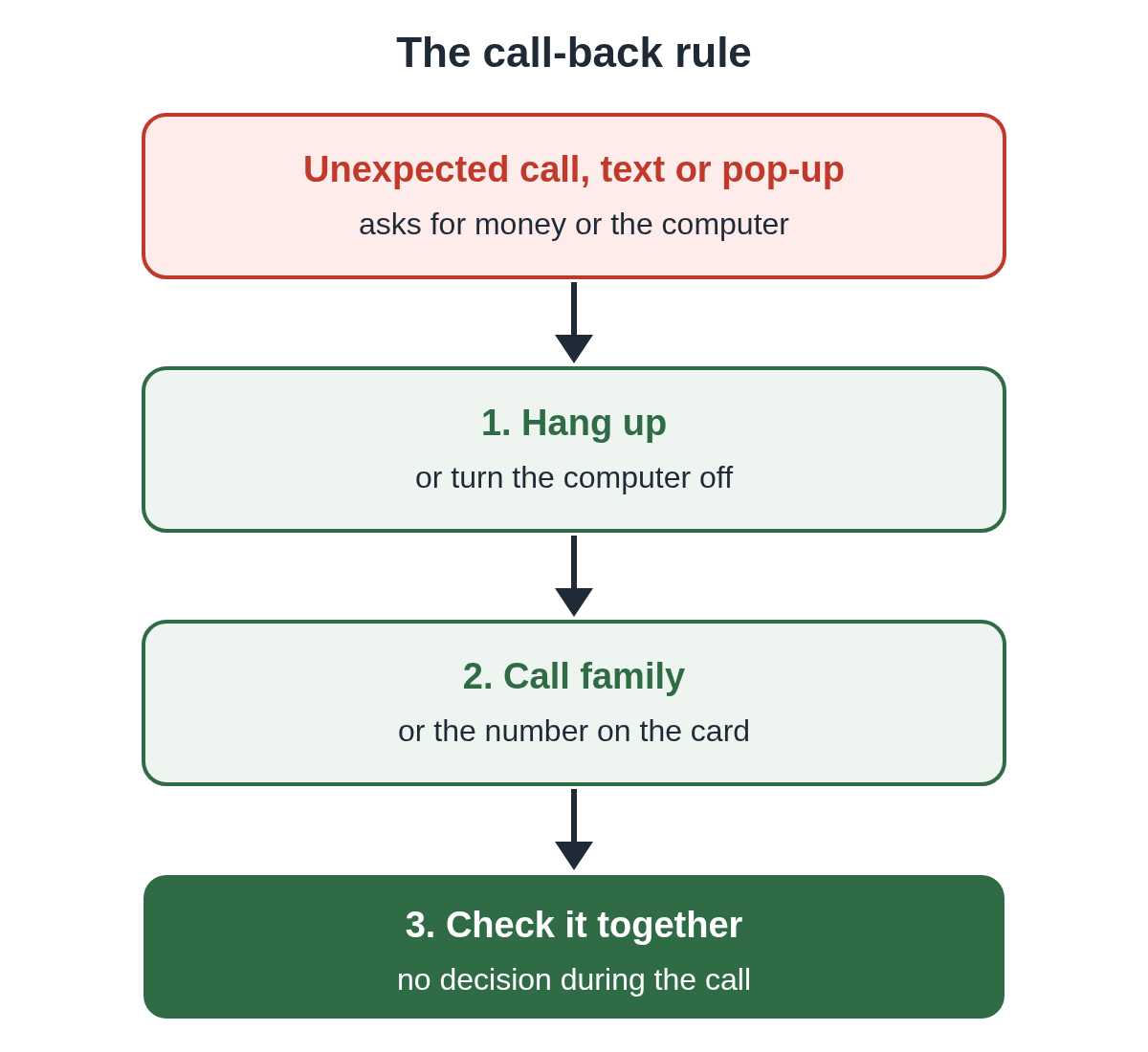
The second half matters as much as the first. Make it clear they will never annoy you by calling. A parent who worries about bothering you is more likely to keep talking to the caller.
What to say about the scams they're most likely to hear
You don't need to cover everything. A few short lines about the common stories are enough, because the same few tricks come back again and again.
A pop-up says the computer is locked and to call a number
"A real Microsoft warning never has a phone number on it. If the screen says to call someone, don't. Turn the computer off and call me."
Microsoft says its error and warning messages never include phone numbers, and that if someone calls claiming to be Microsoft Support, you should hang up (Microsoft). One version going around now is a fake Microsoft Defender pop-up that opens from a Google ad.
The "bank" or "government" says money must be moved to keep it safe
"Nobody real will ever tell you to move your money to protect it. Not the bank, not the government. If someone says that, hang up and call the number on your card."
The FTC says never to transfer or send money because of an unexpected call or message, even when the caller says it's to protect your money, and that government agencies won't ask you to put cash into a Bitcoin ATM or hand it to a courier (FTC).
Someone wants to get onto the computer
"If someone you didn't call asks you to install something or read them a code, that's how they get in. Say no and hang up."
Tools like AnyDesk, TeamViewer and Quick Assist are normal support tools. The trouble starts when a stranger is the one asking. We explain the difference in is AnyDesk safe?, and our Quick Assist guide covers the "read me the code" version.
A grandchild is in trouble and needs money now
"If a grandchild calls needing money, hang up and call them back on the number you already have. If you can't reach them, call me."
Anyone who wants gift cards, wire transfers or crypto
"Gift cards are for presents. Nobody real takes payment in gift cards."
Microsoft says it will never ask you to pay for support in gift cards or cryptocurrency such as Bitcoin.
Why do scammers tell people to keep it secret?
Because a second opinion ends the scam. The FBI warns that in grandparent scams, callers tell victims to keep it secret, sometimes claiming a judge has ordered silence and that breaking it will land the grandchild in jail. The FBI's advice is to call someone else in the family, even if the scammers said to keep it secret (FBI IC3).
So turn the secrecy into the signal:
"If anyone ever tells you not to tell me, that's exactly when you should."
This is the single most useful sentence in this whole post. It works for every scam, including the ones that haven't been invented yet.
What if my parent gets defensive?
Don't push and don't argue. Some people hear "scam talk" as "you think I'm losing it." A few things that help:
- Talk about yourself. Mention a scam text or call you got and how close it looked to the real thing.
- Ask for their help. The FTC's Pass It On program was made for older adults to share what they know with friends. Ask your parent to warn their friends about the pop-up scam. People take advice more easily when they're the ones giving it.
- Hand over something short. The FTC has a free tech support scams page and printable bookmarks that say it in a few lines.
- Come back to it later. One calm five-minute chat beats one long uncomfortable one.
How do I keep the conversation going?
Make it normal, not a one-time warning. Ask "had any strange calls lately?" the way you'd ask about the weather. When you see a new scam, send it over with "this one's going around." Our scam alerts are written for exactly that.
And when they do call you about a suspicious message, thank them, even if it turns out to be real. That call is the habit you're building.
What if it already happened?
Keep your voice calm. They'll already feel terrible, and if the first thing they hear is blame, they may not tell you next time. Then work through our two-minute checklist together: disconnect the PC from the internet, call the bank from another phone, and change the email password from another device. If a scammer got onto the computer, follow what to do when a scammer had remote access to a parent's computer.
Back the talk up on the computer
The conversation does most of the work, and a few settings help too. Our guide on protecting a parent's computer from scammers when you live far away lists the ones worth checking on your next visit.
If you'd like a safety net for the moment the rule is forgotten, Xcelcor Guardian lowers the risk on a Windows 11 PC. Every new remote connection, from AnyDesk, TeamViewer, Quick Assist, ScreenConnect and others, is held until you approve it by email or on our website. Your parent's screen only has a Refuse button, so there's nothing for a caller to talk them into. It doesn't see their screen, files or banking, and it doesn't stop every scam. See how it works for families.
Print the card below with the rule and the scripts, fill in your number, and leave a copy by the phone and the computer.
Phone-side card: what to do when someone calls about money or your computer (PDF)
More posts like this are in Protecting parents.
Questions people ask
How do I tell my parent they're being scammed?
Stay calm and ask questions instead of accusing: who called, what they asked for, and whether anyone said to keep it quiet. Then check together using a number you already trust, like the one on their bank card. If money or computer access is involved, work through our checklist.
What is the one thing I should tell my parent about scams?
That anyone who tells them to keep a call secret is the person they should tell you about. The FBI advises calling another family member even if a caller said to keep it secret.
Will Microsoft ever call or show a pop-up with a phone number?
No. Microsoft says its error and warning messages never include phone numbers, and that you should hang up on unsolicited calls from anyone claiming to be Microsoft Support.
Sources
- FTC: Pass It On
- FTC Pass It On: Tech support scams
- FTC: Business and government impersonators go after older adults' life savings (August 2025)
- FBI IC3 PSA: Grandparent scams and secrecy (November 2023)
- Microsoft: Protect yourself from tech support scams
- FTC: This month, Pass It On to help someone you know avoid a scam (May 2026)
Reviewed by Dana Cross, Trust & Distribution, on .
Last updated